President's Message
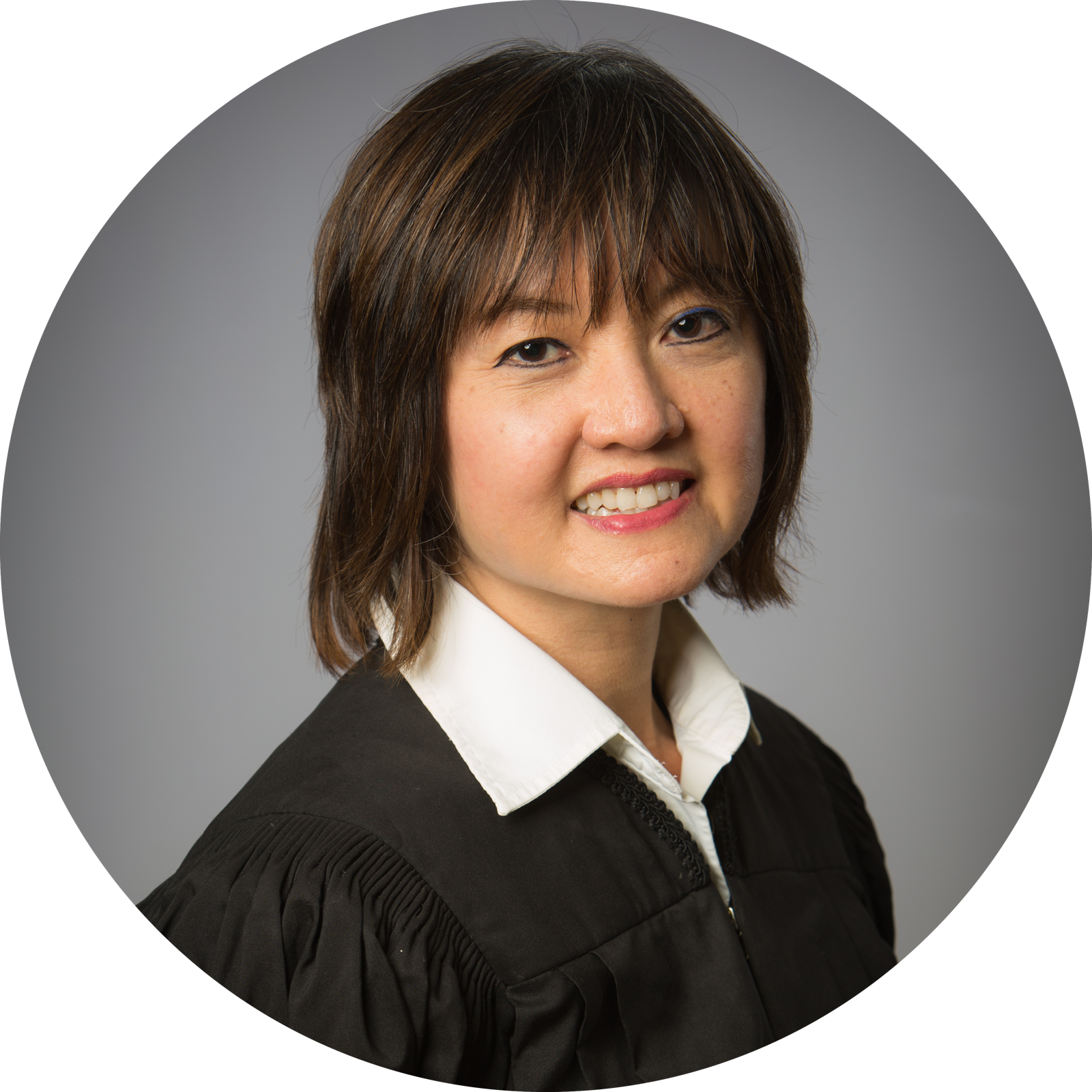
Judge Audra Ibarra
(Santa Clara)
"Mom, are all presiding judges women?"
My eleven-year-old son asked me this question as I was getting ready to be sworn in as a judge in Santa Clara County. The question made my heart both soar and sink.
It soared because I raised him—and his seven-year-old sister—to believe that their potential is limitless, that leadership has no gender and that anything is possible. Coincidentally, every court leader he had met had been a woman. The year before, he had been my date at the State of the Judiciary, where he had met then–Chief Justice Tani Cantil-Sakauye and Santa Clara County Presiding Judge Patricia Lucas. And on the day of my swearing-in, the new presiding judge, Deborah Ryan, would administer the oath.
My heart sank because I know reality falls short of this ideal. Women do not hold even half of the leadership roles in the judiciary. In California—where women make up half the population—we comprise just 43 percent of the bench, according to the most recent 2024 demographics report. And beyond the courts, the pattern persists. There are big jobs a woman has never held. Most obvious, there has never been a woman president and never a woman governor of California.
At California Women Judges, we confront these truths directly. We ask the hard questions: How do we promote gender equity? How do we ensure diversity of perspective—both in our courts and in the communities we serve?
Our programs touch on gender issues in courts throughout the country (with National Center for State Courts CEO Beth Clement on March 11) and in other professions, like finance (with Lesley King) and culinary arts (with Traci Des Jardins on March 26). From this broad perspective, we learn from the challenges, opportunities and successes of our sisters in other states and other sectors.
Our programs feature female trailblazers in the California judiciary, like the first Asian Filipino American chief justice (Tani Cantil-Sakauye), the first woman and LGBTQ+ person Judicial Council administrative director (Shelley Curran), the first female Jewish appellate justice (Sheila Sonenshine), the first and only woman veteran appellate justice (Eileen Moore) and the first openly lesbian appellate justice (Therese Stewart). Our newsletters spotlight members (so far Sam Jessner, Serena Murillo, Amy Yerkey and in this edition Terry Truong), who like CWJ, have made it their mission to support and empower other women bench officers. They share their stories and wisdom so that we might follow in their footsteps.
Our programs provide practical guidance for growth and leadership, like discussions on serving as a presiding judge (with Judith Clark, Maureen Hallahan, Maria Hernandez, Sam Jessner and Lisa Rogan), on serving as a pro tem appellate justice (with Mary Greenwood, Teri Jackson and Natalie Stone) and on responding to bias in the courts (on April 23). This edition of our newsletter even includes advice on running in a contested re-election (from Monique Wilson). And we are connecting members for mentorship. So that all of us can reach our full potential in the judiciary and be our best on the bench.
This edition of our newsletter is dedicated to all the women who raise their voices, share their experiences and contribute to our ongoing conversation to eliminate bias in the judicial branch and beyond.
CWJ Launches Internship & Scholarship Program for California 1Ls
By Judge Holly Fujie (Los Angeles, Ret.) & Comm. Jennifer Baronoff (Los Angeles)
"The only source of knowledge is experience." — Albert Einstein
CWJ's Law School Internship and Scholarship Committee co-chairs Judge Holly Fujie (ret.) and Los Angeles Superior Court Commissioner Jennifer Baronoff have been working hard to launch a summer Internship and Scholarship Program for 1Ls in California law schools. In its initial format, the Internship program will be open to 1Ls at all accredited California law schools. See the attached flyer announcing the program to law schools. The students will submit an application and current resume to the Committee, c/o Commissioner Baronoff (Jbaronoff@lacourt.org) by January 31, 2026.
CWJ members have generously volunteered to host interns for this first year of the program in the Los Angeles, Solano, Stanislaus, Orange, San Bernardino, Tulare, San Francisco, Fresno and Santa Clara Superior Courts, and Past CWJ President Judge Michelle Williams Court has even offered to host an extern at the U.S. District Court for the Central District of California! The Committee will forward all applications to participating judicial officers in the counties for which each Applicant has applied.
Each judicial officer can then choose the Applicant(s) they are willing to host for the summer, based upon the application, resume and an optional interview (in person or virtual). The judicial officers will then inform the Committee through Commissioner Baronoff of their choice(s) on or before February 28th. The first participating judicial officer to inform the Committee of her decision to select a particular Applicant will be informed that she can contact the Applicant directly, with a copy to Jbaronoff@lacourt.org, to inform that Applicant of the selection. The other participating judicial officers from that court will be informed that said Applicant is no longer available to be chosen and to make their choice from the remaining Applicants. Applicants who are not selected by a participating judicial officer will be notified by March 15, 2026.
All Applicants placed with a CWJ member through this program will have the opportunity to be considered for one $1,000 scholarship. Selection will be made by the Committee based upon a short essay to be submitted with the Application.
If you are a judicial officer on one of the above courts and have questions or are willing to host an intern this summer, but have yet to sign up via the CWJ survey, please send an email to the Committee at Jbaronoff@lacourt.org we will forward any applications for your court when they are received.

Hold onto your Seat: Practical Tips for the Challenged
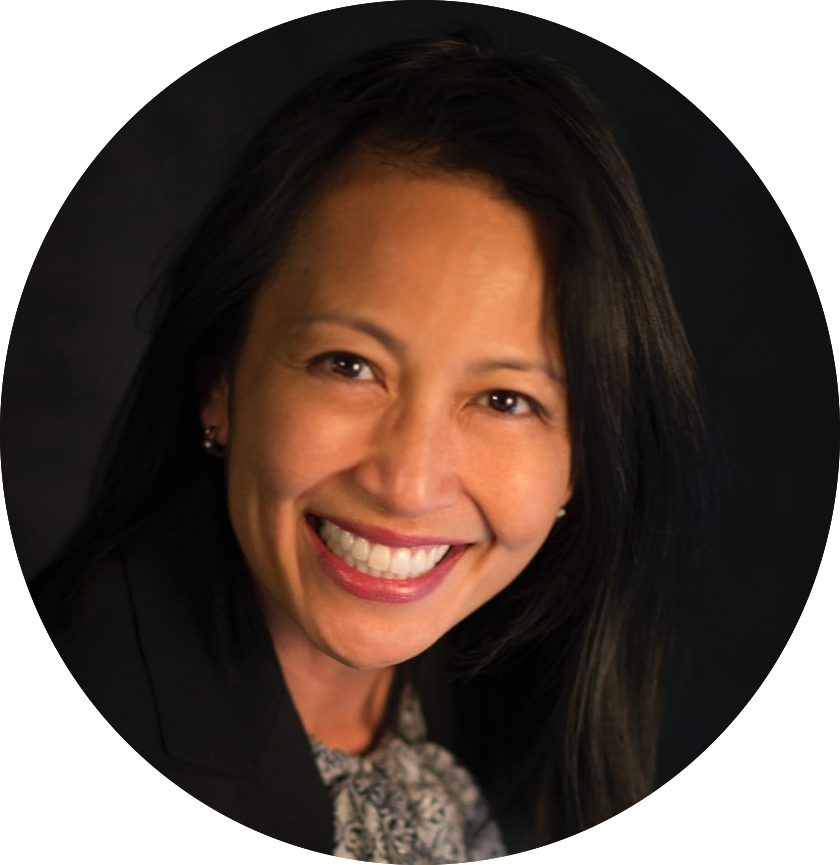
By Justice Monique Langhorne Wilson, Court of Appeal, First Appellate District
"If they don't give you a seat at the table, bring a folding chair." — Shirley Chisholm1
If you are like me, you've had to bring your folding chair to a lot of tables to get to where you are. When your judicial seat is challenged, it feels like that chair is literally being jerked right from under you…because in some ways, it is. You worked so hard to achieve your goal of becoming a judge, you are sitting pretty (or so you think) and then…yank! Once you learn that your seat is being challenged, it seems like your world is being turned upside down. I recall that very feeling back in 2019, when I went through this process. After serving faithfully as a commissioner for over twelve-plus years, being passed over four times and a host of other disappointing experiences, I was finally elevated. It had only been about ten months since my appointment as a judge, and we had not had a contested judicial election in Napa County in over 35 years. So, when I went to the Elections department, I was just going to fill out the necessary paperwork, pay my fee and be on my merry way as others had done in the recent past. Little did I know that I would get the shock of my life.
While these tips won't guarantee the outcome of the election, if you follow them, you will at least feel confident that you fought a good fight. So, plan ahead, utilize your resources and most importantly relax and stay calm on the journey. While it might feel like someone has pulled your chair from under you, it does not have to be your reality that you fall and never recover. In fact, what might seem like a setback, may be a setup for a brighter future.
Election Tip #1: Contact your local Elections Department3
One of the things I would recommend to anyone in a retention election is to make an appointment with someone in the Elections Department and write out a list of questions before you go. This will ensure that you get all the information you need to be successful. You want to inquire about important deadlines, Campaign Finance Forms, Candidate Filing Fees, Required Qualifications Documents, the Code of Fair Campaign Practices, and your Declaration of Candidacy. It will seem like a lot (because it is), but gather all the information they have to offer and start preparing your campaign information file bin. It will help you stay organized. Also, don't be shy about visiting the Elections Department as often as you need. They are there to assist.
Election Tip #2: Alert your family, friends and colleagues
Whenever I have any issues, I always consult with and lean on my family and close friends, so my retention election was no different. As I did after having my "pity party" that day in my car, I would encourage you to contact your family to let them know the gravity of your situation. (i.e. If I don't win, I am out of a job) Then, you must contact everyone (and I mean E-VER-Y-ONE) you know as you will need help from all of them in one way or another, whether it is financial, physical, and/or emotional support during this process. All your colleagues, your extended family and friends, associates, etc. will be your mouthpiece that will reach people and spread your name throughout places in your county that you may not be able to physically get to during the campaign.
Election Tip #3: Reach out to other judges who have been challenged in the past
I cannot stress how important it is to reach out to other judges, in your county but also outside your county for support. In my case, I had no choice but to look beyond the judges at my court to find assistance as no one on my bench had ever faced a challenge to their seat. I was fortunate to be put in contact with two very knowledgeable judges who helped me through this process. In fact, one had experienced the very same thing when he was a newly appointed judge. It was so comforting to be able to talk with him and have another shoulder to cry on. Through this connection, I was introduced to others who had walked the path I was embarking upon, and I became privy to additional resources, tips and ideas on how to run a successful campaign.
Election Tip #4: Complete a Judicial Campaign Ethics Course
Canon 5B(3)5 requires every candidate for judicial office to complete a judicial campaign ethics course approved by the Supreme Court. In collaboration with the California Judges Association (CJA) and the State Bar of California, the Center of Judicial Education & Research (CJER) offers a primer course on judicial campaign ethics.6 It is a 1.5-hour, self-guided course that covers topics such as, Campaign Funds, Campaign Conduct, Campaign Speech, and Disqualification/Disclosure. It begins with an overview of the California Code of Judicial Ethics (Canons), but you will want to continue to consult the Canons and other resources like Rothman7 during your campaign. There is a tab within the course that provides links to other valuable judicial campaign resources. This course was a lifesaver as it helped me understand the process and provided a lot of information about the rules governing judicial elections that I did not know.
Election Tip #5: Form a Campaign Committee8
It is extremely important to form your campaign committee as soon as possible. As the saying goes, "K.I.S.S.- Keep It Simple…" Your committee can simply consist of you, your campaign manager, consultant and treasurer. You can also add others to your committee list if you so choose, but it is not necessary that they be official committee members to be of assistance to you.
Campaign Manager:
A campaign manager will assist you with day-to-day campaign needs and scheduling. You want to hire someone who you trust (preferably who knows you) and who has the time and availability to devote to your campaign. My mentor judge served in this capacity on my committee.
Campaign Consultant:
A campaign consultant will assist you with campaign strategy and will likely have contacts for campaign support. (i.e. signs, venues for fundraising, forum/debate opportunities) Be sure to interview multiple people for this position. You want someone who is knowledgeable about judicial campaigns and someone who knows the "politics" in your county.
Campaign Treasurer:
Having a professional treasurer is crucial. It is imperative that you interview multiple people for this job and check their references. Be sure the person has experience as a treasurer for judicial elections. If the treasurer fails to timely file campaign statements with the Fair Political Practices Commission (FPPC), you can face heavy penalties and public admonishment for the treasurer's actions or inactions.
Campaign Address:
Due to obvious safety concerns, you must keep your personal residence address private and separate from campaign activities. I recommend that you obtain a Post Office Box address for your retention campaign. Your fundraising envelopes, website, brochures and other materials will likely have the campaign address listed on them. Therefore, you should set this up right away so your materials can be printed expeditiously.
Election Tip #6: Organize Fundraising Events10
In any campaign, you need money. (FACTS!) Judicial campaigns are no different. This is the only time that we as judicial officers can solicit funds for a candidate.9 Full disclosure…asking for money was the most uncomfortable part of the campaign, but I had to put on my big girl pants and do it…so if I can, you can too. I would recommend you have between 2-3 large fundraisers and small ones as needed. If at all possible, have your campaign treasurer at the events. If not, have someone else handle the money. In addition to your written records, take pictures of all money received, including envelopes.
Election Tip #7: Connect with California Judges Association (CJA)
Judicial Excellence Together (JET-PAC) is sponsored by the California Judges Association.11 It is funded solely by donations and provides funds for judges facing electoral challenges. I learned about this financial resource from a judge who faced a challenge in another jurisdiction. I was fortunate to receive JET-PAC funds to help with the financial needs of my campaign. CJA also offers Ethics workshops/webinars, brochure on Ethics in Judicial Elections, an Ethics Committee Referral line, and networking with other judges across the state. CJA proved to be a very valuable resource for me. There may be other Political Action Committees within your local organizations or affinity groups you belong to. I implore you to seek out all available funding opportunities within the bounds of our Judicial Canons. It is better to have and not need, than to need and not have.
Election Tip #8: Secure Endorsements12
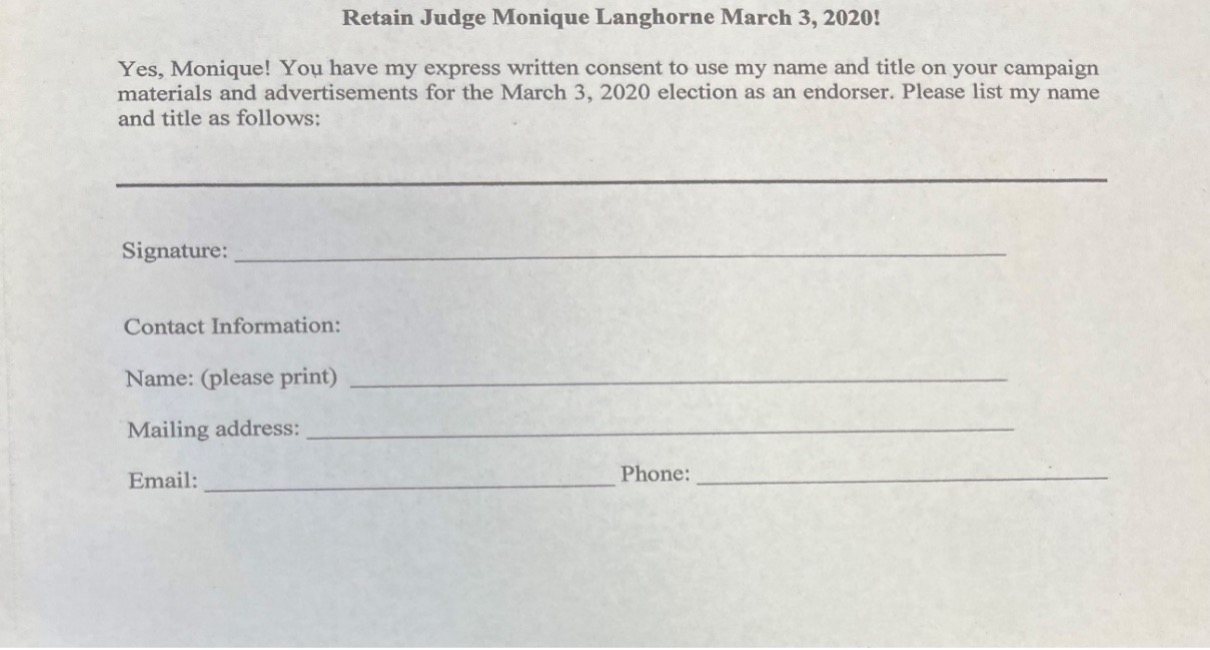
I suggest obtaining endorsements from as many people and organizations as soon as possible. For example: All sitting and retired judges, local Newspaper Editorial boards, local attorneys, city officials, Board of Supervisors, Community leaders, judges in other jurisdictions, service organizations (ex. Rotary/Kiwanis), the Chamber of Commerce, and Law Enforcement Associations. Please note that it is important to obtain written consent for all endorsements and keep good records. Your endorsement cards can be fancy, or you can keep them simple.
Election Tip #9: Publicity, Publicity, and more Publicity
Community Events:13
It is a must that you get as much publicity as possible. Visibility is the key. Get your name out there and attend as many events as humanly possible. When available at local events, apply for a booth to set up your folding chair and tent to hand out literature and meet members of the community, participate in local 5k/10k races and bring along friends and family wearing your campaign buttons/sweatshirts/t-shirts etc. Speak at local schools for career day, contact your Chamber of Commerce and reach out to different affinity groups to speak at their meetings. Attend community celebrations and visit local church services/events. You never know who you will meet and how those interactions will positively affect you. During my campaign, I was able to meet a lot of great people that I might not have, but for my retention election. This, of course, helped me for the election, but it also had a greater impact on my career then I could have ever imagined.
Participate in forums:
During any election cycle, many groups will host candidate forums. (For example: Central Committee for Democrats/Republicans, League of Women voters, local business owners, local unions) Your campaign consultant and/or manager should sign you up to attend. If not, sign yourself up and go.
Coffees:
These are small gatherings/meet and greets (usually in someone's home) with friends/family/neighbors of the homeowner designed to introduce the candidate, answer questions about qualifications and ask for donations. You should ask as many people as possible in all areas of your county to host. Start with your friends, colleagues and retired judges. Be prepared to say a few words about who you are, your experience on the bench and your judicial philosophy. Have campaign materials available to hand out to the invited guests.
Local tv shows, radio, podcasts:
During campaign season, most local shows/media outlets will ask you to come on their programs for an interview with the other candidates for free. You can also advertise for a fee, of course. Either way, don't overlook this opportunity to gain exposure on the airwaves.
Campaign paraphernalia:14
You always need to have something to hand out to potential voters on the campaign trail. Order business cards, yard signs, brochures, and fundraising envelopes as soon as possible. You or your representative may have to contact City Hall in every city in your county for details as they may all have different policies on size and placement of signage. Campaign paraphernalia such as clothing, buttons, pens, water bottles etc. are helpful to spread your name throughout the community. I recommend you order a professional name tag to wear when you are out and about.
Create a website:15
In this day and age, having an online presence is necessary. On your website, include information about you, your qualifications, pictures of you at community events, your endorsements and how people can volunteer and donate to your campaign. Remind them to register to vote, stress the date of the election, but also to vote early (when possible) and to vote for you. It seems elementary, but some first-time voters or people who don't vote regularly might not be certain if they are registered or even be aware of the date to vote.
Social media: Facebook/Instagram etc.:
You will want to set up a professional campaign page; separate from any personal page you may already have on social media. Just like your campaign website, post upcoming events, pictures of you out in the community, donation information, encourage voting for you, and stress the date of the election. Be sure to tag other people in your photos.
This is by no means an exhaustive list of ways to enhance your visibility.4 Be creative and think outside the box. The key is to spread your name around the county so that voters remember you at the ballot box.
Election Tip #10: Take Care of Yourself
Unless you can take time off, you presumably will work all day in your judicial capacity and then participate in your campaign activities in the evenings and on weekends. I remember having such a packed schedule during my campaign season and being extremely exhausted. Campaigns are not for the faint of heart. So, hold onto your seat because your chair will feel like it's attached to a roller coaster ride. Therefore, it is vital that you schedule time for self-care or you will become ill and/or burn out very quickly. Pray, meditate, do breathing exercises, schedule a massage and spend a little time with family and friends when possible, (I did all the above). Do what works for you to maintain your stamina and manage your stress for the duration of the campaign.
Footnotes
1 Shirley Chisholm was the first Black woman elected to Congress and the first Black woman to seek a major party's presidential nomination
2 Reference to "Peanuts" a comic strip written and illustrated by Charles M. Schulz, 1950-2000
3 I would recommend all judges do this and gather information in advance so when/if the time comes, you are prepared.
4 This is by no means an exhaustive list.
5 See Canon 5B(3) for specifics
6 See https://www2.courtinfo.ca.gov/cjer/judicial/3807.htm
7 Rothman, David et al., California Judicial Conduct Handbook (4th ed. 2017)
8 See Gov. Code §§84213, 91000, and Canon 5B(2)
9 See Canon 5A(3) and Advisory Committee Commentary
10 This really depends on the size of your county. If you are in a larger county, you may need to fundraise a lot more than I had to in a smaller county like Napa.
11 For requirements, see https://www.caljudges.org/jetpac.asp
12 You will have to disclose any endorsements/donations-including date and amount- on the record for two years after the election for anyone appearing before you in court. I kept a copy of my list of endorsements on the bench so I could consult it every day and I disclosed the information on the record when required. For specifics, consult Canon 3E(2)(a), Canon 3E(2)(b) and the Advisory Committee Commentary, Code of Civil Procedure (CCP) 170.1(a)(9)(C)
13 I won the election with over 80% of the vote. Additionally, one very special person I met during my campaign opened opportunities for me to pro tem at the Court of Appeal in 2023 and helped pave the way to my appointment to the First District in 2024.
14 Your materials must say, "Paid for by [campaign committee name]"- For all requirements, see https://www.fppc.ca.gov/learn/campaign-rules/campaign-advertising-requirements-restrictions.html
15 See Government Code §8314 prohibiting the use of public resources for campaign activity. See also Cal. Judges Assn., Judicial Ethics Update (1997) p. 10, prohibiting the use of court facilities for campaign activities.
Standing Tall for Justice: 3rd California Women Judges Distinguished Speaker Series Program
By Michelle Ialeggio, San Diego Superior Court and President-Elect of California Women Judges
California Women Judges was honored to host a compelling member-only installment of its Distinguished Speakers Series on December 18, 2025, featuring an in-depth conversation between Justice Lee Edmon and Michelle "Shelley" Curran, Administrative Director of the California Judicial Council.
Justice Edmon—Board Member of California Women Judges and Presiding Justice of the Second District Court of Appeal, Division Three—interviewed Ms. Curran, whose career spans two branches of government and whose leadership has helped shape the administration of justice throughout California. Ms. Curran is the first woman and the first openly LGBTQ person to serve permanently as Administrative Director of the Judicial Council.
Ms. Curran reflected on her upbringing in Indiana as one of ten children, including seven sisters. She described her childhood as deeply formative, noting that she remains extraordinarily close with her siblings. Before his passing when she was just 13 years old, her father instilled in her a belief that she and her siblings could accomplish anything—telling her that if she wanted to cure cancer, she could. After his death, Ms. Curran's mother stepped into a strong leadership role as head of the household, modeling resilience and strength at a time when women still faced significant barriers to leadership.
Ms. Curran began her public service career in public policy, eventually working for the California Senate President Pro Tempore. She described loving her time in the Legislature, even while being on call around the clock. Through her work on public safety issues, she became closely familiar with the Judicial Council and ultimately made the decision to move to the judicial branch after recognizing its essential role in sustaining democracy.
Justice Edmon noted that Ms. Curran has served with the Judicial Council since 2009. During that time, she has worked on evidence-based sentencing initiatives and, under Chief Justice Tani Cantil-Sakauye, played a significant role in bail reform—work Ms. Curran described as "really wonderful and important." Although SB-10 was later repealed by ballot initiative, she observed that the foundational ideas it introduced continue to influence reform efforts.
A central theme of the discussion was leadership and the importance of women lifting one another as they advance. Ms. Curran emphasized that the very existence of California Women Judges is integral to effective leadership, encouraging women in leadership positions to open doors for others and give credit where it is due.
Ms. Curran spoke passionately about access to justice as a cornerstone of democracy. She emphasized that people must feel seen and heard in court for the system to work effectively. She highlighted Judicial Council initiatives focused on language access, judicial diversity, addressing the burden of fines and fees, and expanding remote access—when appropriate—to reduce barriers such as missed work or childcare challenges.
The conversation also underscored the importance of diversity across race, gender, socioeconomic background, geography, and court size. Ms. Curran emphasized that better decision-making results when diverse perspectives are included. "We need everybody," she said. She also stressed the importance of judicial discretion and encouraged judges to engage directly with the Judicial Council, noting that it is strongest when informed by the experiences of those on the bench.
Justice Edmon credited Ms. Curran with having a reputation for being especially approachable, a quality that has strengthened trust and collaboration across the judicial branch.
On a personal note, despite Ms. Curran's impressive height at five feet eleven inches, which she feels only helped her in roles of leadership, she never herself played basketball. However, Ms. Curran shares a love of the sport, particularly the WNBA and women's college basketball, and her annual tradition of traveling with one of her sisters to watch NCAA games. She is married to her wife, Bonnie, and together they are raising two children. Ms. Curran spoke candidly about balancing leadership and motherhood, crediting a supportive spouse and intentional family time. She exemplifies the thoughtful, inclusive leadership celebrated by California Women Judges.
Years of Judicial Service:
17+, in total
Why I do what I do:
It started in elementary school when I would play make-believe as a teacher and made my younger brothers be the students.
It continued in college when I volunteered with afterschool programs tutoring and mentoring children in low-income neighborhoods.
It carried over to my professional career when I stumbled upon a court system – Dependency – that I had never heard of and was drawn to.
The "It" is my affinity to working with children. And I have been doing it on and off for the last 30+ years, first as an attorney representing children and parents in the dependency system, then as a research attorney and eventually as a referee, commissioner and now judge in the juvenile court.
But why do I do what I do? The Juvenile Court is not an easy assignment. It deals with emotionally difficult situations and decision-making every day. In fact, the dependency court has not had a reputation for being a sought-after assignment. But when I was asked to participate in a 2024 training focusing on why I and two other judges, one in Family Law and the other in Probate, do what we do, it made me stop and truly think about the answer.
I have presided over both dependency and juvenile justice cases. I currently sit in a specialty court, hearing non-minor dependent cases involving foster youth between the ages of 18 to 21 who are not ready to be on their own and need guidance and assistance, financial and emotional, to live independently.
I chose to return to a juvenile assignment because of the lives we can touch and because of the successes that we do not hear about often enough. I chose to stay because I get to work with a group of colleagues statewide who care tremendously about their work, with attorneys who fight vigorously for their clients, with social workers who go above and beyond their duties, and with young adults who are some of the most resilient individuals I have met. I chose to stay in a juvenile assignment:
Because of the attorneys who care enough to become experts in areas like traumatic brain injury or public assistance, to better represent their clients.
Because of attorneys who take their clients' phone calls late at night or early in the morning because that is when they are needed.
Because of attorneys who care enough about collaboration to try and work out the best possible plans for children and youth rather than what should be done.
Because of social workers who care about children and young adults, who spend the time talking to them about their foster care experience and about their achievements and ability to overcome the negative statistics that come with being a foster youth.
Because of social workers who spend their own money to buy children and young adults a meal, hygiene products or necessary items for their child.
Because of social workers who care about their clients enough to drive around Los Angeles County in places where their clients have been known to hang out to provide them with services.
Because of the young man who overcame his criminal mistakes and chaotic home environment to soon graduate from a prestigious college with a plan to attend law school.
Because of the young mother of two children who, at the age of 21 works part-time and recognizing the importance of education, finds time to attend community college to make a better life for herself and her children.
Because of the young man who graduated from a University of California at the age of 20 and wants to be lawyer and pursue founding a non-profit to help former foster youth establish stable housing and employment.
Because of the young man who is passionate about baseball and even though his life has not gone the way he had hoped, he continues to play and help coach younger players because that has been the one constant in his life.
This is not to say that we do not have less than successful stories in the juvenile system because we do, but I remain optimistic (and maybe somewhat idealistic) that those of us who work in the juvenile system can effect change and at the end of the day, "do small things in great ways."
Best advice you've received about being a judge:
Be kind. You don't know what the other person is going through.
Why CWJ?
There are camaraderie and kindred spirit among women judicial officers that is hard to identify but easy to recognize. That is what the California Women Judges provides for me.
Favorite Quote:
"If I cannot do great things, then I can do small things in great ways." — Martin Luther King Jr.
Walk, Run, or Bike with CWJ in 2026!
Is there something you've always wanted to do, but NO ONE wanted to do it with you?
CWJ's got you covered!
The CWJ Events Committee is planning on hosting or promoting social events that will enrich our membership and encourage connection with colleagues statewide. The near constant attacks on the independence of the judiciary require that we prioritize our health and focus on self-care, and exercise is a critical part of self-care. CWJ is designating 2026 as the year of "Refresh and Renew" and to start off the year, we are inviting our members who ride bikes to participate in the 50th Cinderella Classic Bike Ride in Dublin, California on April 11, 2026.
The Cinderella Classic Bike Ride
Early spring is the perfect time to ride through the beautiful rolling hills of the San Francisco Bay's Tri-Valley area. CWJ cyclists will join other riders for the 50th Cinderella Classic in Dublin, California, on Saturday, April 11, 2026.

Participate in the Saturday ride:
- Four routes to choose from (21, 42, 64, 91) - each route is fully SAG supported.
- Rest stops with food and drinks with a post-ride lunch plus optional beer/wine for purchase.
- All routes bypass busy intersections.
CWJ Dinner on Saturday evening
After the ride, CWJ bikers and those who just want to go to dinner and socialize will gather at a local restaurant.
If you are coming for the Classic and plan to stay overnight, the Marriott Bishop Ranch Hotel will have a block of rooms reserved and available at a group rate.
If you are interested in attending, please contact Monica Wiley at mwiley@sftc.org for more information.
GET READY FOR MORE OPPORTUNITIES LIKE THIS TO GET TOGETHER!
This is only the first of many events we plan to bring you in 2026. Is there something you've always wanted to do, but would love it if others did it with you? The Events Committee wants to encourage CWJ members to participate in events that get us moving and together!
Please contact Social Committee Chairs Judge Monica Wiley mwiley@sftc.org or Judge Connie Quinones cquiones@lacourt.org with your ideas and let's Refresh and Renew in 2026!
Crafting Justice: Stress-Crocheting My Way Through Five Years of Family Law
By: Judge Wendy McGuire Coats (Contra Costa)
Welcome to our first installment of our Crafting Justice column.

We were eighteen months into the pandemic, and I was nine months into my family law assignment. I kept hearing the refrain from primary assignment orientation that the families just need "a good enough judge" but I felt overwhelmed by the volume, the intensity, and the weight of family court – the all of it. I was drowning and in desperate need of stress relief. At the same time, my kiddo demanded my attention, specifically to watch three full television series—The Vampire Diaries, The Originals, and Legacies. Having to make decisions about where kids slept underscored the importance of prioritizing time with my middle schooler after court ended, but it was hard to ignore the stew of emotions I felt at the end of each day.
I remember being floored by the gorgeous, cross-stitched Lady Justice my colleague Judge Christine Donovan had in her chambers. I envied her ability to make something beautiful, but I especially envied her creative outlet. I also remember watching diver Tom Daley knit during the 2020 Tokyo Olympics as a stress reliever. I'm not exactly sure how I chose crochet. Years ago, I had tried and failed at knitting. In no mood to fail again, I got an owl crochet kit from Amazon and promptly failed miserably. The directions were indecipherable and printed on a glossy piece of paper the size of a credit card. Struggling at our kitchen table, I went looking for directions on "how to read" a crochet pattern, when I stumbled onto a different crochet kit by the Woobles. Not only did I find a crochet kit for a true beginner, but I also found helpful video tutorials on the Woobles website.
I completed my very first crochet project, a little blue penguin named Pierre, on September 14, 2021. I bought more yarn and made more Pierres.
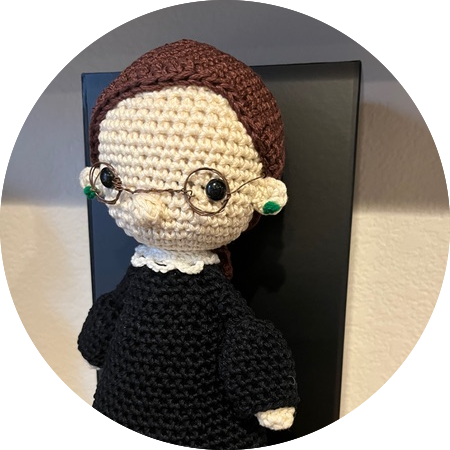
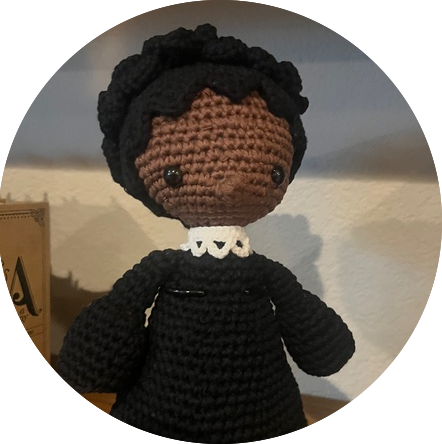
I took a break from Pierre and returned to the owl. Parked on our couch with my kid for hundreds of episodes of The Vampire Diaries, my prolific production is directly proportionate to the amount of stress I carried through this assignment. I mass-produced penguins, owls, and then elephants giving them away as whimsical gifts. My first book of patterns, "Crochet Iconic Women" by Carla Mitrani and her Ruther Bader Ginsberg pattern launched me in a whole new direction. After a few successful RBGs, I tried my hand at crocheting some of the iconic judicial women in my own life.
My new crotchet skills are the most unexpected gift from my five years in Family. Six months into it, I doubted I could stay the expected three years, and I would have jumped at the chance to move sooner. But with this new stress-crocheting outlet, working the yarn was not only meditative but also a physical release. I don't crochet clothes or bigger projects. I depend on the accomplishment of quick completion of these small children's toys. I look forward to surprising the project's recipient. Over time, the trinity of creating, completing, and giving away provided me an evening routine that managed to dilute the heaviness of my workday. When I started crocheting in September 2021, I could never have imagined that this new skill would not only support me through two years in Family Law but also would lead to me volunteering for an additional three years in our dedicated domestic violence restraining order calendar. I had no clue that a little ball of blue yarn, a single crochet hook, and a tiny penguin would change so much. The assignment's high volume and emotionally intense challenges never changed but this new skill changed me in the assignment and that's what made the difference.
Calling all crafters, makers, artists, and hobbyists!
We would love to share your work and your story in our Crafting Justice column.
Uplift-Her Celebrations
Judge Terri Mockler
Judge of the Year
Contra Costa County
55th Annual Judges' Night Gala
Alameda-Contra Costa Trial Lawyers Association
January 29, 2026
Judge Amy Guerra
CWJ Board Member & Co-Editor CWJ Newsletter
Fresno County
On February 19, 2026 Governor Newsom appointed her to serve as an Associate Justice of the Fifth District Court of Appeal.
See You There
Distinguished Speaker Series: Overcoming Gender Issues in Judiciaries Throughout the Country
Wednesday, March 11, 2026, at 12:15 PM via Zoom
Justice Teri Jackson, Presiding Justice First District Court of Appeal, Division 5 will interview Beth Clement, the President and CEO of the National Center for State Courts and the former Chief Justice of the Michigan Supreme Court. At the NCSC, she is known for her commitment to judicial independence and vision for courts that serve everyone fairly, efficiently and transparently. In the Michigan Supreme Court, she focused on modernizing the state's court system and enhancing access to justice. Join us to hear about her career and experiences leading the NCSC and Michigan judiciary, the challenges she overcame as a woman jurist and her thoughts on overcoming gender issues in all state courts.
This is an exclusive member event. Member registration for the event is required to receive a Zoom link. Click to register.
Intro to Menopause/Perimenopause with Allison Craig
Thursday March 19, 2026 at 12:15 PM via Zoom
Our Education Committee will host presenter, Allison Craig, co-producer of a women's health podcast, "The V Movement."
Click to register
Distinguished Speaker Series
Thursday March 26, 2026 at 12:15 PM via Zoom
Justice Lee Edmon will interview celebrity chef and philanthropist Traci Des Jardins
Click to register
Cinderella Classic Bike Ride & Dinner
Saturday April 11, 2026 • Dublin, CA
Join CWJ members for the bike race or dinner or both.
How to React to Comments in the Courtroom
Thursday, April 23, 2026 at 12:15 PM via Zoom
Our Education Committee will host a confidential question and speaker response conversation - details coming soon via email
CWJ gathering at CJA Spring Conference
April 30 – May 2, 2026 • Indian Wells, CA
Be on the lookout for details as we hope to gather together again.
Here We Grow
We are thrilled to welcome our newest members since our last newsletter. As CWJ continues to grow, we look forward to hearing from you and connecting you to a committee as we build CWJ together.
Judge Marsha Amin (San Diego)
Associate Justice, Jose Castillo (Court of Appeal, Fourth District, Division One)
Commissioner Heather Chang (Alameda County)
Judge Stephanie Clarke (Contra Costa)
Judge Wendy Dier (Modoc)
Judge Lianne Dumas (San Francisco County)
Judge Sarah Ellenberg (Los Angeles County)
Stephanie Jamieson (Merced)
Judge (ret.) Janet Kintner (San Diego)
U.S. District Judge Linda Lopez (U.S. District Court Southern District of California)
Judge Carolina Lugo (Los Angeles County)
Administrative Presiding Justice Judith McConnell (Court of Appeal, Fourth District)
Judge Ai Mori (San Francisco)
Commissioner Lucia Murillo (Los Angeles County)
Judge Tiana Murillo (Los Angeles County)
Judge Lucia Murillo (Los Angeles County)
Judge Melanie Ochoa (Los Angeles)
Commissioner Grace Pak (Amador County)
Judge Joshlyn Pulliam (Riverside)
Judge Erin Reed (Los Angeles)
Judge Lisa Rogan (San Bernardino)
Judge Wendy Segall (Los Angeles)
Judge Stephanie Story (Los Angeles)
Judge Ashley Tabaddor (San Fernando Court)
Presiding Justice Alison Tucher (Court of Appeal, First Appellate District, Division Three)
Judge Elizabeth Ulsh (San Bernardino)
Judge Julie Wilensky (Alameda County)
Judge Alison Worthington (State Bar Court)